Remembering ourselves back to the wild
Women’s thighs have at times been political, co-opted by culture-wars. Beyoncé, Serena – their strength seemingly a threat. Here however, on this large canvas, strong thighs are celebrated in an expanse of pattern. And this pattern flows like water, washing over the skin in pools, channels, gyres. The body, powered by swell. Reborn.
In rough, unsteady seas, we might be swallowed by the ocean. But the ocean is also a realm of memory – a place where, if any, we might find something to reclaim. It is here in her depths that Dominican-American artist, Firelei Báez (b. Dominican Republic 1981) relinquishes history to memory, expanding the space for rediscovery: souls, sex, skins – borderless, without bounds.
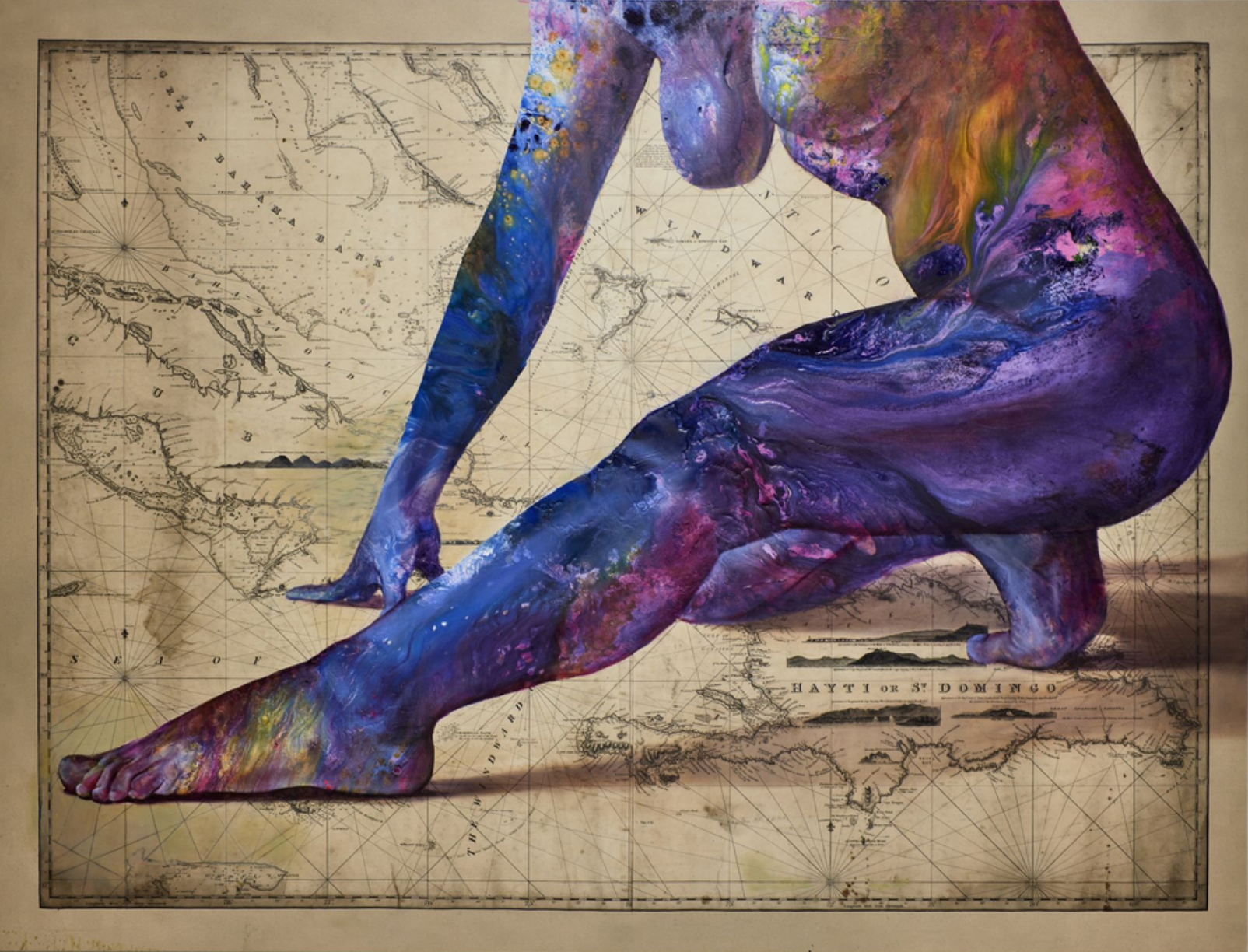
Untitled (New Chart of the Windward Passages), 2020, Firelei Báez[1]
Where old maps mark old ideas, Báez casts new impressions. Counteracting the colonising march of statistics, schematics and cartography, comes flesh, feathers, fronds and fruits. They challenge: Do you remember?
In 2024, Trust Memory over History, a collection of recent works by Báez showed at the Louisiana in Denmark[2] and at Kunstmuseum Wolfsburg in Germany[3]. I was in Copenhagen on a work trip, craving human interaction. But having finally stepped away from my computer discovered that here too, in person, we were a collection of scripts ‘interfacing’ with one another. I felt no closer to humanity than had I stayed at my desk.
I escaped the city and found myself an hour north, standing in front of Fruta Fina, Fruta Estraña (Lee Monument), (2022), moved by its succulent fruits. I wanted to suck them, crush them, with scant care for the juice that would run from my chin, the blood-red that would stain my teeth, the scene I might cause. When I was engorged I would wipe my juicy, bloody hands on something inappropriate, marking it for decommission.
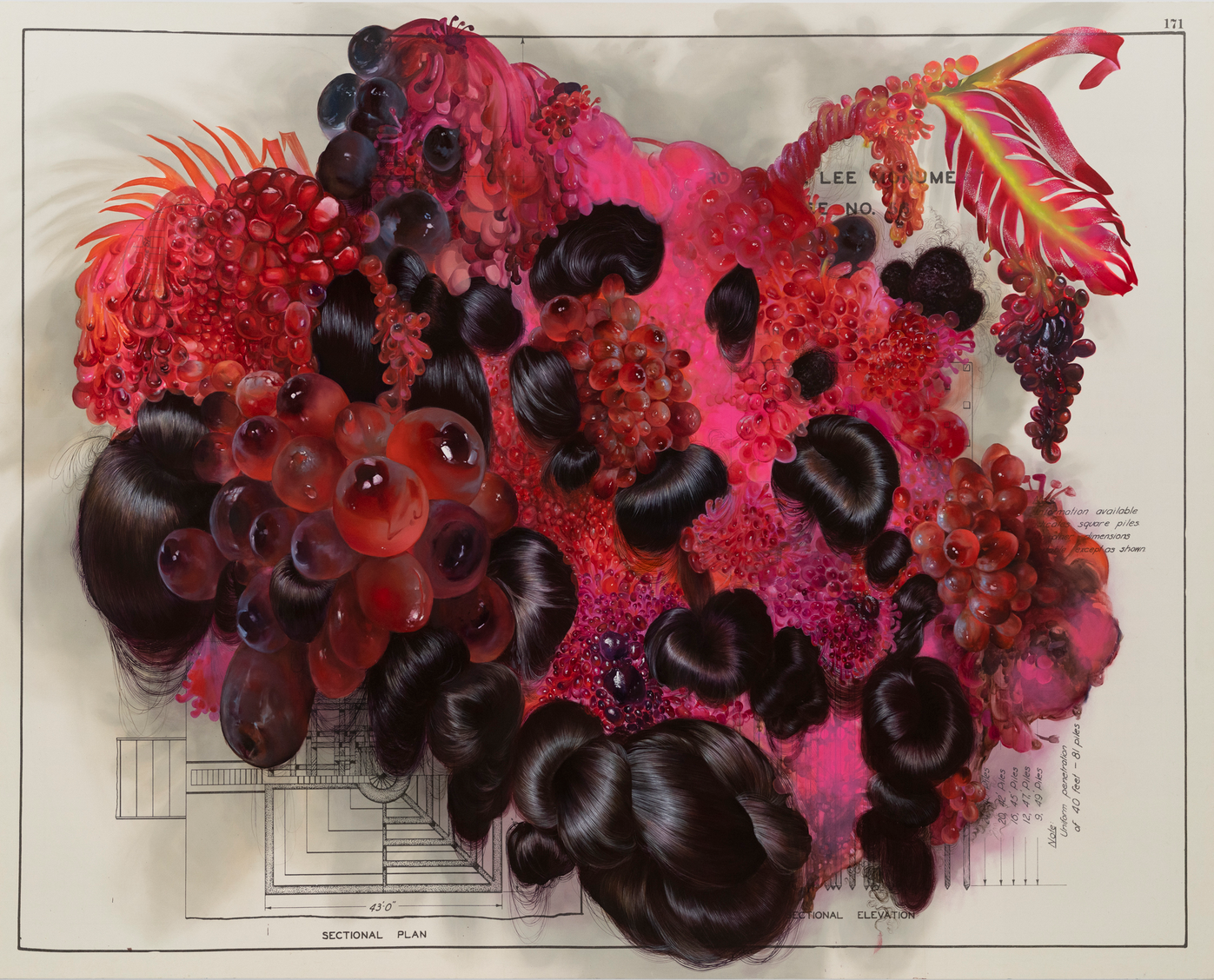
Fruta Fina, Fruta Estrańa (Lee Monument) 2022, Firelei Báez[4]
Báez is of course concerned with something far bigger than my hunger for small rebellions, but it touches me despite all the points of departure between this lived experience and mine. It touches me exactly because I am human. It angers me for the same reason too.
RIP Robert Lee. And good riddance.
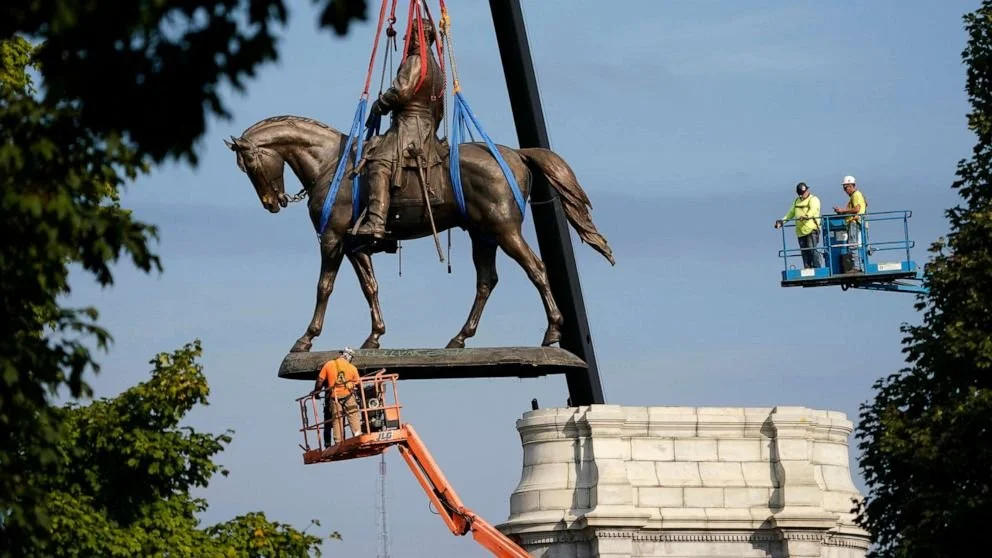
The confederate statue of Robert Lee being removed in Richmond, Virginia.[5]
The Trans-Atlantic slave trade underscores Báez’s work. The people lost to it and forever altered by it – born or unborn – over subsequent generations are revived, revered. Báez is attributed in the catalogue foreword as creating an “expansion of one’s vocabulary”, but it’s even more than that. This space, these rooms and this collection create an expansion of feeling and understanding.
Art of course can do that. Nikole Hannah-Jones’s New York Times podcast, 1619[6], was detailed and illuminating. But the first four minutes of episode one pierce in a way that only the evocative can. Set against the sounds of waves lapping and thirsting at the shore, we are instantly transported. Hannah-Jones says:
“They say our people were born on the water.”
The poetic weight of those words – fewer than ten – is deeply felt. When she goes on to say: “They had been made black by those who believed themselves to be white”, you understand that it is in that transition, that trans-location over the water – the Middle Passage – something tragic, irreversible and catalytic occurred. Water gives and takes life, water is a gulf, a severance. Water is a baptism.
We were all altered, irredeemably. Báez examines how a dislocated population will necessarily re-invent, and how Western ‘history’ is incorporated into these new fiction/s. As is imposed regularly by the West on others, the West’s hold on history will be tested, bent, sometimes snapped. And as memory is excavated, what’s unearthed might return us to other forgotten, overlooked paths, and what’s reimagined might enliven possibilities for an alternate future. The influence of Black culture is ever-present, and contemporary exhibitions as alive and rich as this are not only history-shifting, but underscored with a forward propulsion.
Báez grew up surrounded by myths that marry elements of African voodoo, deities and sea sirens. One figure featuring in these myths is the ‘ciguapa’, subject of the work: Ciguapa Habilis, (2010). When I see it I’m struck. It could as much be me. A self-portrait. There I am, confronted with myself. I look around, do they know it’s me? Can others recognise the likeness? It was the me as ciguapa who had a dream once, where with this exact body, in the stretch between my umbilical cord and pubic line, I scraped. I scraped and scraped, scratching away at my skin until eventually, a wooden penis appeared. I kept scratching despite the shock and terror, and the kind of rapidly rising excitement that tastes like nausea. I clawed at the wooden penis until my nails tore away and splinters pierced my fingertips.
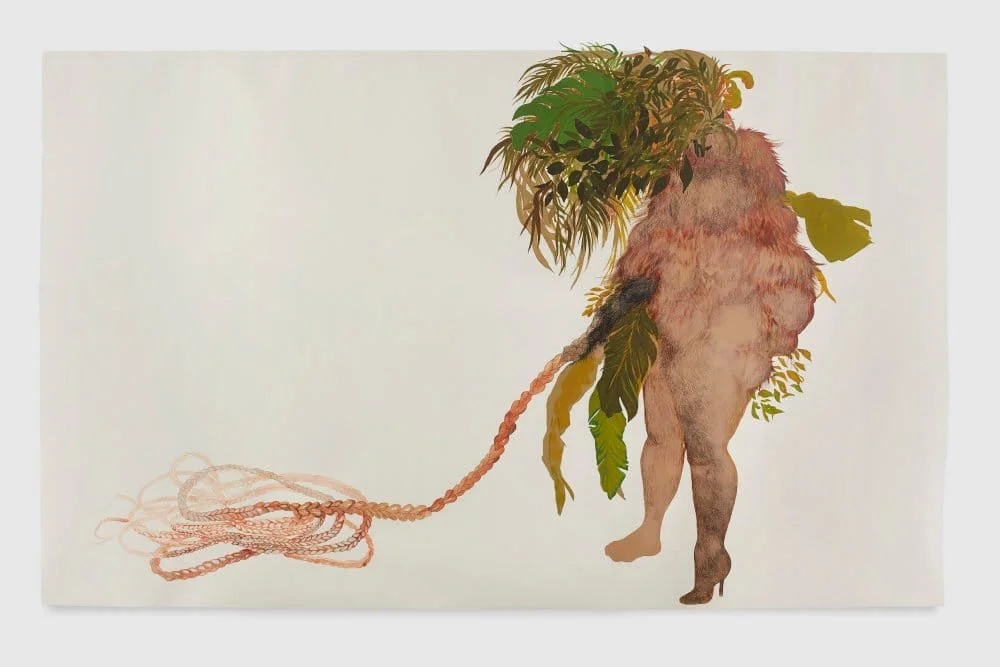
Ciguapa Habilis, 2010, Firelei Báez
This has nothing to do with the penis in real or abstract form. It has nothing to do with its relationship to male biology. Rather, it was the discovery that everything always has been and is contained within us. Or it was, once. We chip away at it, boxed in by rules. We choose to conform, or have conformity imposed upon us. And we forget we were ever everything. Unrestrained. Wild.
In the 1992 book, Women Who Run with the Wolves[7], author Clarissa Pinkola Estés issues an edict, writing: “it is necessary for women to return to their instinctive lives, their deepest knowing, so, let us push on now and remember ourselves back to the wild soul.” She draws on and interprets old stories from around the world to guide us back to the ‘Wild Woman’ – to her wisdom and knowing. To get there, she writes, “all one might need, all that we might need, is still whispering from the bones of story”. Stories like those that Báez brings to life. There are other bodies in these stories. Many-legged bodies. Bodies that are animal, vegetable, mineral. Bodies that are abundant – that feed and shelter. Bodies that offer: nest in my folds, eat from my fruit. When it was all there, simpatico, did you really need to beat it out of us? Rape it out of us? Domesticate and tame us?
Báez’s bodies are reclaiming themselves, and inviting us to do the same. A wall text explains: “Báez employs the ciguapa as an image of freedom in relation to landscape, gender and race. A creature that cannot be controlled or contained.” Similarly, Pinkola Estés guides us: “the doors to the world of the wild Self are few but precious. If you have a deep scar, that is a door, if you have an old, old story, that is a door. If you love the sky and water so much you almost cannot bear it, that is a door.” Báez ‘In conversation’ affirms that: “whenever I invoke the ciguapa, I’m thinking about ways of finding connections and expanding our ideas about what a human self can be.” This is an open door.
In the same conversation about her work, Báez brings us into the present. Which is where we need to be politically, particularly after seeing an exhibition like this. “We are in one of the most bountiful times in human history. There are no technical reasons for so much lack to happen. But we keep creating these moments of scarcity,” she says. Worst of all, we keep creating the conditions for slavery to persist. In the 1619 podcast, sociologist, Matthew Desmond details the links between violence, productivity and money and the “impunity for profiteers” who benefitted from economies of brutality. And the same can be seen today.
Ian Urbina is a journalist whose organisation, The Outlaw Ocean[8], (and podcast of the same name) investigates and exposes cases of modern slavery. Words like trafficked, chattel, debt-bonded and shackled are sadly still applicable. In episode three of season one, he states: “there are more enslaved workers today than at any other time in human history; and a large number of them are at sea… When they die, they’re thrown in the water”.
The bones continue to pile up.
Urbina, often at great risk to himself, boards Thai ships, Chinese ships, speaking to deckhands – often Indonesian, Burmese, Cambodian; always desperate. And their testimonies are brutal. He reports: “beatings were routine, disappearances were common. The defiant were beheaded. The sick were cast overboard. More than 50% had witnessed murder.”
There are currently two seasons of the podcast available. It's a hard listen. I find myself clutching at the kind of magical thinking Báez references in her work. As explained in the catalogue essay by Marta Fernández Campa, the work Untitled (Drexciya), 2020, evokes Afrofuturism through reference to the Detroit-based musical duo Drexciya, “who, in their 1992 album Deep Sea Dweller, re-imagined a future for the Drexciyans: babies of the African mothers who were drowned in the Middle Passage and who were imagined having been birthed in the Sea, going on to build a civilisation of survival there.”
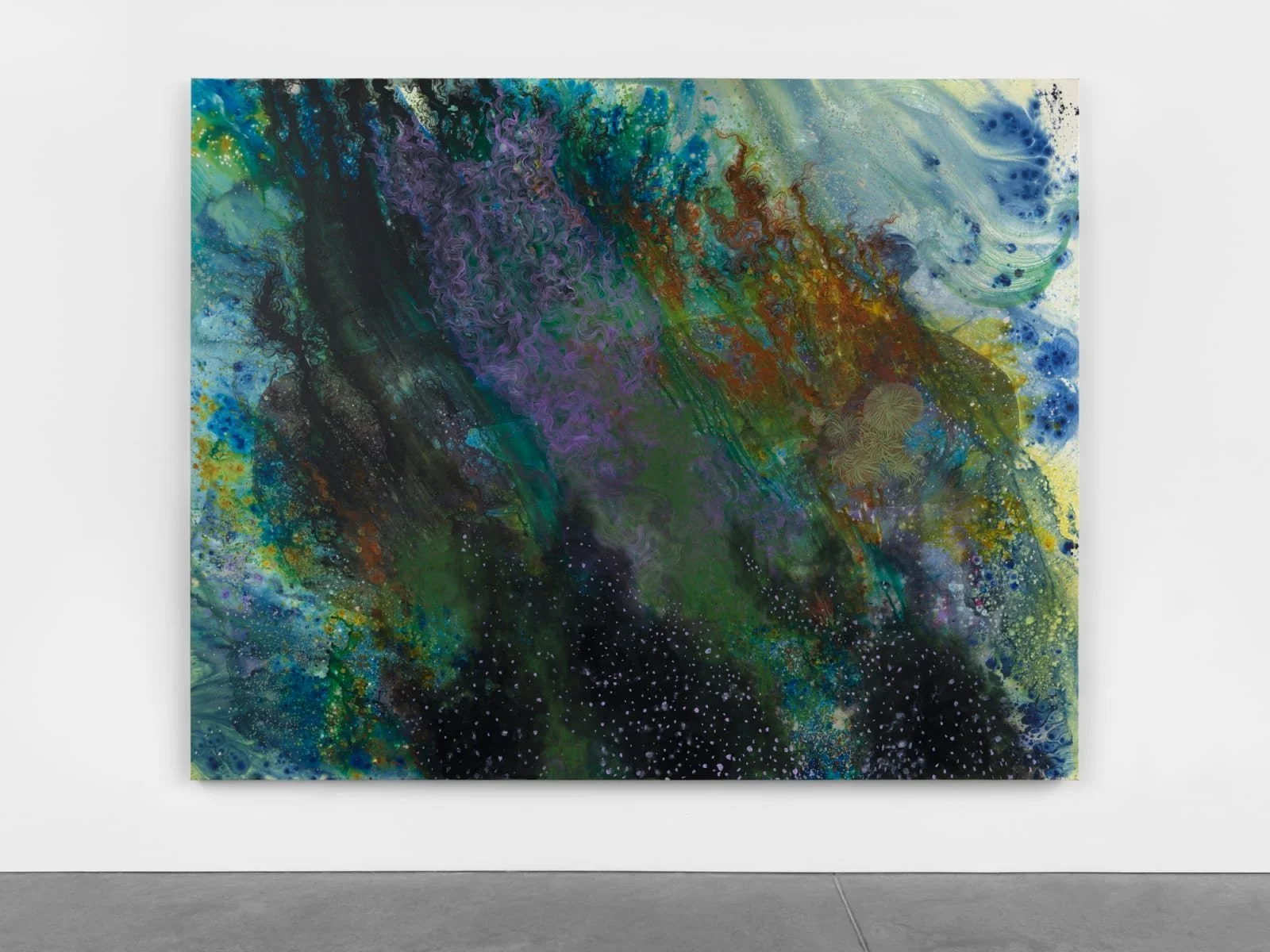
Untitled (Drexciya), Firelei Báez [9]
I clutch because I’m complicit. And I have to imagine some kind of future where the stories of those lost at sea are kept alive, where a dark history becomes explosive, generative. Where the sound, song, colour and criticism can come into the light.
In his Outlaw Ocean podcast investigations, Urbina points out that while it might be the Thai and Chinese fleets engaged in slavery today, yesterday it was the Soviet, Japanese and Spanish fleets. And before that of course, it was the Portuguese. The Brazilian census of 2022 told another side of that story, when for the first time the largest racial group identified as mixed-race – outnumbering those who identify as white 92 to 88 million. As reported by Naiara Galarraga Gortázar in El Pais[10], “Five million slaves were brutally and forcibly brought to the Portuguese Empire in the Americas from Africa over the course of 350 years, laying the foundations of what would become Brazil.” Ending only in 1888, 20 years after it was abolished in the United States, she explains: “[Slaves in Brazil] labored in horrific conditions on sugar plantations or in gold mines. In no other country in America was slavery so long-lasting.”
Another excellent exhibition, Between Your Teeth[11], demonstrated the depths and complexities of the relationship between Portugal and Brazil. In 2025, the Calouste Gulbenkian Foundation in Lisbon brought together a major collection of works by Portuguese artist Paula Rego (b. Lisbon 1935 – 2022) and Brazilian artist Adriana Varejão (b. Rio di Janeiro 1964) – artists who have engaged in ‘dialogue’ during their careers and whose work, through exceptional curation, produced a visual conversation that perfectly explored these tensions.
Room 1: “I was a Land, a Womb, a Torn Sail”, places Rego’s ‘The First Mass in Brazil’ between Varejão’s ‘Map of Lopo Homem’ and ‘Bastard Son II’. Throughout the exhibition, the works, their placement, the wall texts and catalogue all complemented and built on each other, greatly elevating the overall experience. I’m not sure I’ve seen a better example of curatorial handling[12].
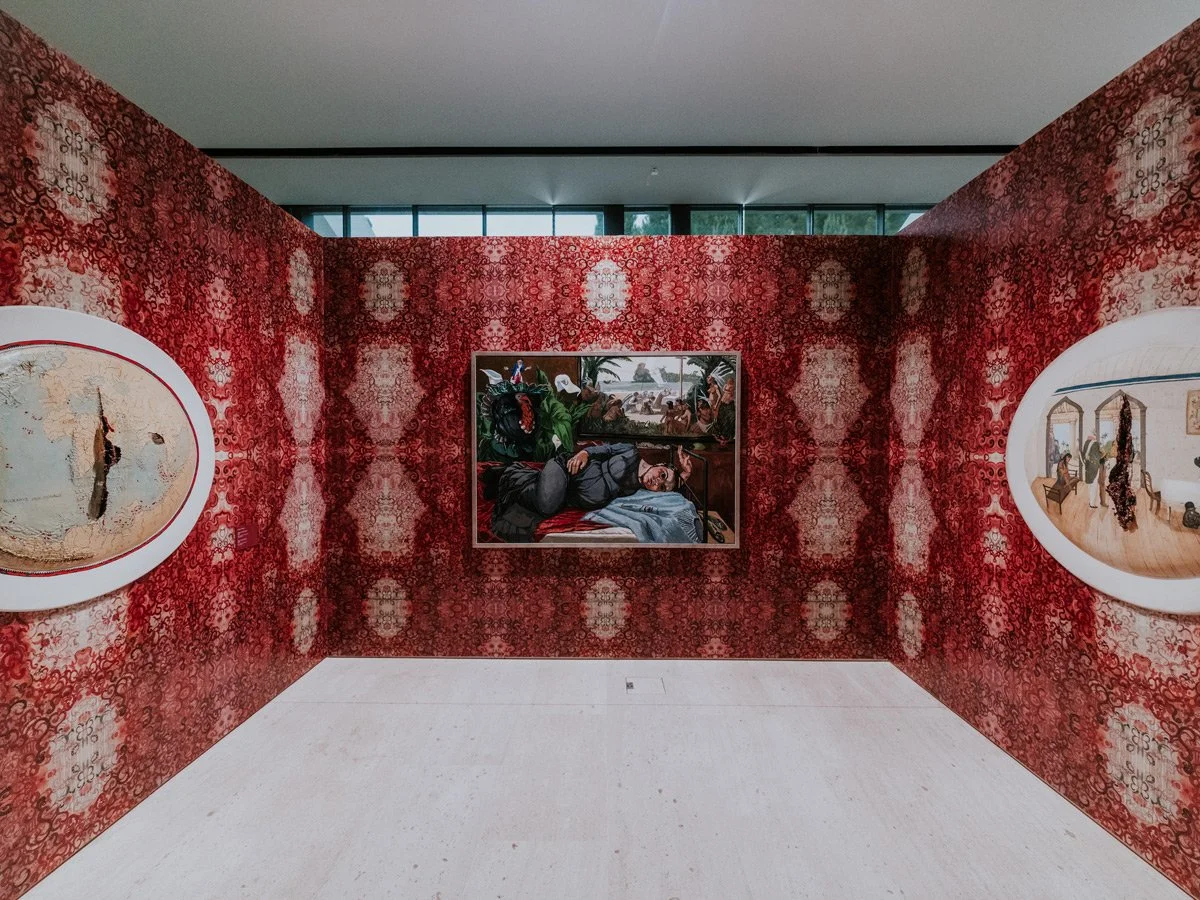
Room 1, installation view, CAM
“Rego shifts the gaze from the traditional religious scene to a pregnant woman in the foreground, thereby suggesting that colonisation was not just a territorial and religious project, but also a process that traversed female bodies, imposing a system of control and erasure.” The wall text reads.
It continues: “[Varejão’s] colonial map is burst asunder by a sutured wound, indicating that the violence associated to conquest remains latent and insurmountable.” Of this, Varejão writes in the catalogue: “The bodies of women are triply marginalized – in an intersection of gender, social class, and race.”
When wounds are still raw, they weep. We are, leaky, restless.
We hear the call of the wild.
In Room 13, “The Sea, Where I am to Myself Given back in Salt, Foam and Shell”, the final room, we return to the sea. “Separated by the Atlantic Ocean it is by traversing the ocean that Portugal and Brazil cross paths and their histories intertwine. The construction of Brazilian identity was partly moulded by the traces and remains left behind by this sea.” Three underwater works by Varejão: Ama Divers (2011), Imperfect Pearl (2009) and Water Deity (2009) explore the mysteries and possibilities of what might emerge from this space.
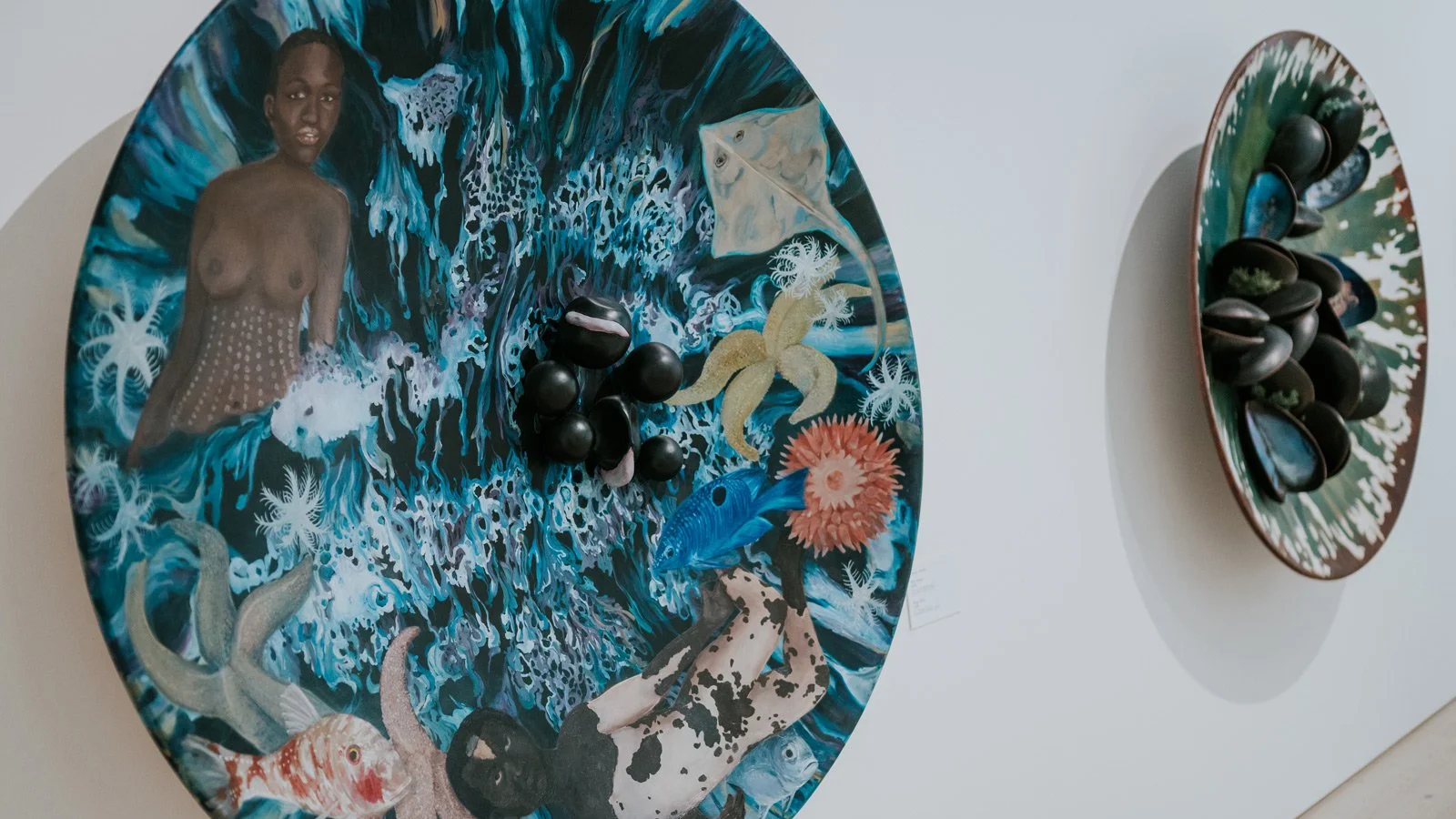
Room 13, installation view, CAM[13]
Today, the results of the census and make-up of Brazil’s society gives me hope. Not as a first step toward a melting pot where reduction results in a safe, bland, sameness. But because when plurality outweighs homogeneity, we may be forced to rediscover how critical coalition building is to rich, harmonious living. In 2025, speaking in Rotterdam[14] after Trump’s second inauguration, Nikole Hannah-Jones expressed just how necessary this will be now, how instead of atomisation and our hyper-focus on each and every difference between us, we acknowledge “our liberation is mutually connected, and so I'm going to fight for you, and you're going to fight for me”. That we recognise that: “even if they don't come for you today, they’ll come for you tomorrow”.
History repeats, so here we have a problem. But memory? Memory is wild, it evolves. Perhaps if we can all live more creatively, something will shift and we might free ourselves from making the same mistakes. Again, and again.
Endnotes:
[1]https://www.jamescohan.com/public-exhibitions/firelei-baez-at-the-bronx-museum-of-the-arts3
[2]https://louisiana.dk/en/exhibition/firelei-baez/
[3]https://www.kunstmuseum.de/en/exhibition/firelei-baez-trust-memory-over-history/
[4]https://www.hauserwirth.com/artists/firelei-baez/?id=firelei-baez&lightbox=fruta-fina-fruta-estraa-lee-monument
[5]https://abcnews.go.com/US/virginia-remove-12-ton-robert-lee-statue-state/story?id=79862294
[6]https://www.nytimes.com/interactive/2019/08/14/magazine/1619-america-slavery.html
[7] Reissued 2022
[8]https://theoutlawocean.com/
[9]https://jamescohan.viewingrooms.com/artworks/22649-firelei-baez-untitled-drexciya-2020/
[10]https://english.elpais.com/international/2024-02-20/its-official-brazil-is-now-more-mixed-than-white.html
[11]https://gulbenkian.pt/cam/en/agenda/paula-rego-and-adriana-varejao/ Installation images © Pedro Pina
[12]Between Your Teeth is curated by Adriana Varejão, Helena de Freitas and Victor Gorgulho
[13]https://gulbenkian.pt/cam/en/agenda/paula-rego-and-adriana-varejao/ Installation images © Pedro Pina